
Has Real Estate in Dubai Become Cheaper Because of the Middle East Crisis in April 2026?
How the War in Iran Is Affecting the Housing Market
In this article, we look at how the military conflict in the Middle East has affected the UAE housing market. You will learn why a stock market sell-off is not the same as a drop in the price of physical property, which segments have come under pressure, and which ones are holding up better.
The geopolitical crisis in the Middle East has called Dubai’s status as a “safe haven” into question after Iranian missile strikes affected infrastructure in the UAE. With the Dubai real estate index on the stock exchange falling and buyer interest weakening, investors are asking whether prices for completed apartments and off-plan property could be next.
If you are thinking about buying property in Dubai now, it is important to understand how to arrange a manager’s cheque, which is required to complete a transaction. 1tab helps make this process fast and legal, even if you do not have a residence visa or a UAE bank account. We handle crypto-to-fiat conversion or money transfers to Dubai, work with the bank, and prepare the required documents — so you can receive the cheque within 1 to 3 days. To get an estimate for your deal, leave a request in the form below.
Has Real Estate in Dubai Become Cheaper?
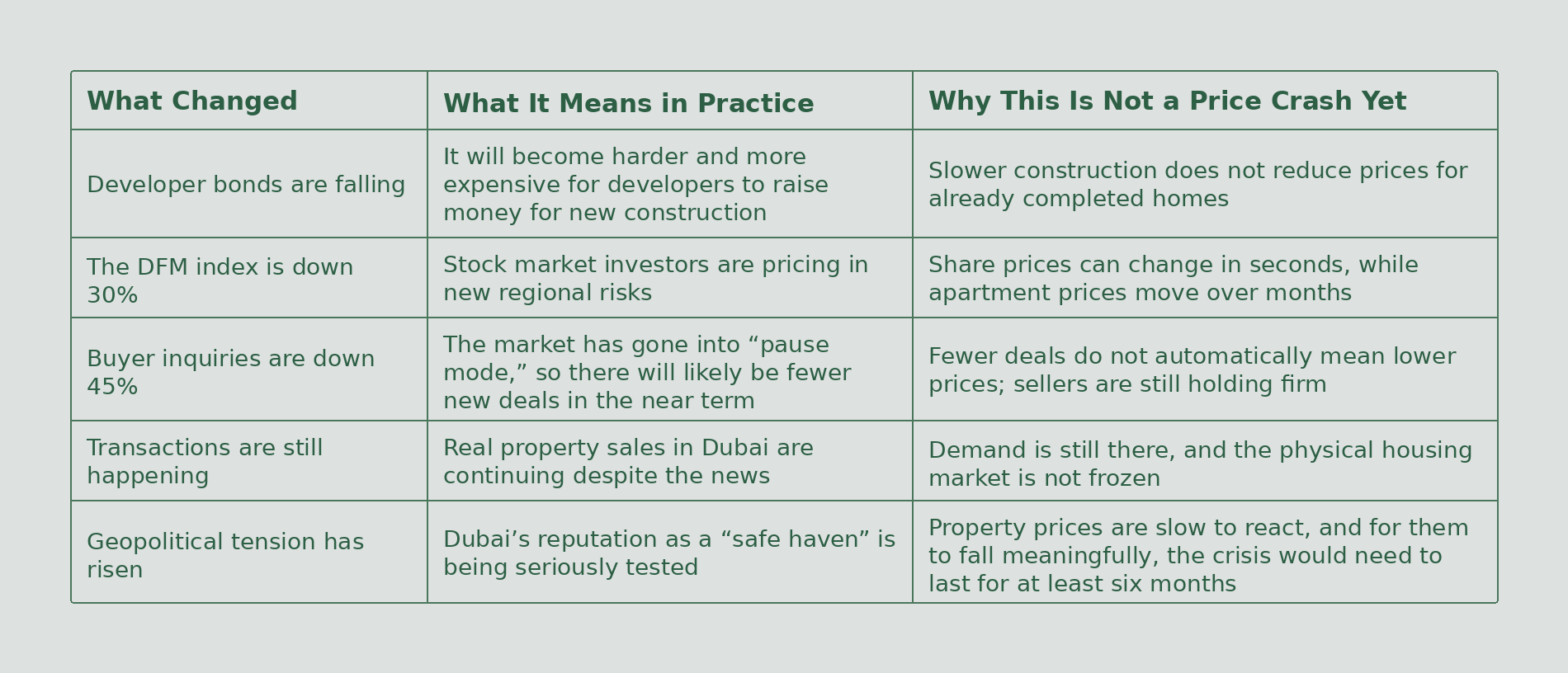
Physical property prices in Dubai have not fallen in line with the stock market. The main mistake being made in the media right now is treating two very different markets as if they were the same. Developer stocks react to news instantly, while the housing market moves much more slowly.
The Dubai Financial Market real estate index has dropped 30% since the start of the conflict, wiping out all of this year’s gains. But those are securities prices, and they can fall within seconds. The property market absorbs shocks much more slowly. First, bad news appears. Then buyers pause, the number of viewings and offers falls, sellers try to hold prices, discounts are offered quietly, and only after that does it start to show up in the official data.
According to the Dubai Land Department, 3,570 deals worth AED 11.93 billion ($3.24 billion) were closed in the emirate between March 2 and March 9. The market slowed down, but it did not stop. What really fell was demand: the number of new inquiries dropped by 45%. The real estate market is slow to react, so this pause in demand is likely to affect prices for completed apartments only after one or two months.
Several investor strategies can now be seen in the UAE real estate market at the same time. Some buyers have taken a wait-and-see approach and are hoping for distress deals — properties sold at a discount by owners who urgently need liquidity. At the same time, there are investors who have simply become more cautious. For a long time, Dubai was seen as an extremely stable market, and the current geopolitical situation has made many people rethink that assumption.
At the same time, it is important to note that both the market itself and the government are acting with confidence. Even in a tense environment, infrastructure is still operating, airports and transport systems are functioning, and the authorities are responding quickly to any risks. For investors, this is more of a positive signal. There are no truly “perfectly safe” markets in the world right now, and the way the UAE is handling the crisis works in its favor.
Vera Tolcheeva, international investment expert with 15 years of experience in global markets
Why the “Safe Haven” Narrative Is Being Tested
Before the escalation, investors were willing to pay more for property in Dubai because they saw the emirate as a protected asset. Now that military action in the region has affected UAE infrastructure, the security factor no longer feels guaranteed. Even so, the market’s core economic drivers — tax advantages and strong returns — are still in place.
Pressure on the premium segment: the number of millionaires in Dubai has doubled over the past 10 years to 81,000. This concentration of wealth makes the market more sensitive: even a small outflow of wealthy residents could quickly weaken demand for luxury housing.
Macroeconomic pressure: higher Brent oil prices are pushing up inflation, which reduces the purchasing power of key investors from India and Europe. If energy prices stay high for a long time, demand from foreign buyers is likely to cool.
For now, anyone expecting a major sell-off has been disappointed. In strong projects — especially waterfront developments and premium properties — there are still no meaningful discounts. Large developers have built up a financial cushion over the past few years, so they are not rushing to cut prices.
That said, some targeted concessions are already starting to appear. For example, developers may cover the registration fee — the well-known 4% charge — or offer more flexible payment plans, with a larger share of the total amount moved closer to handover.
If better conditions do appear, they are more likely to come closer to summer. This is traditionally the low season in the UAE, and combined with the current situation, that is when more noticeable discounts or stronger offers may start to reach the market.
Vera Tolcheeva, international investment expert with 15 years of experience in global markets
Which Properties Are Most at Risk
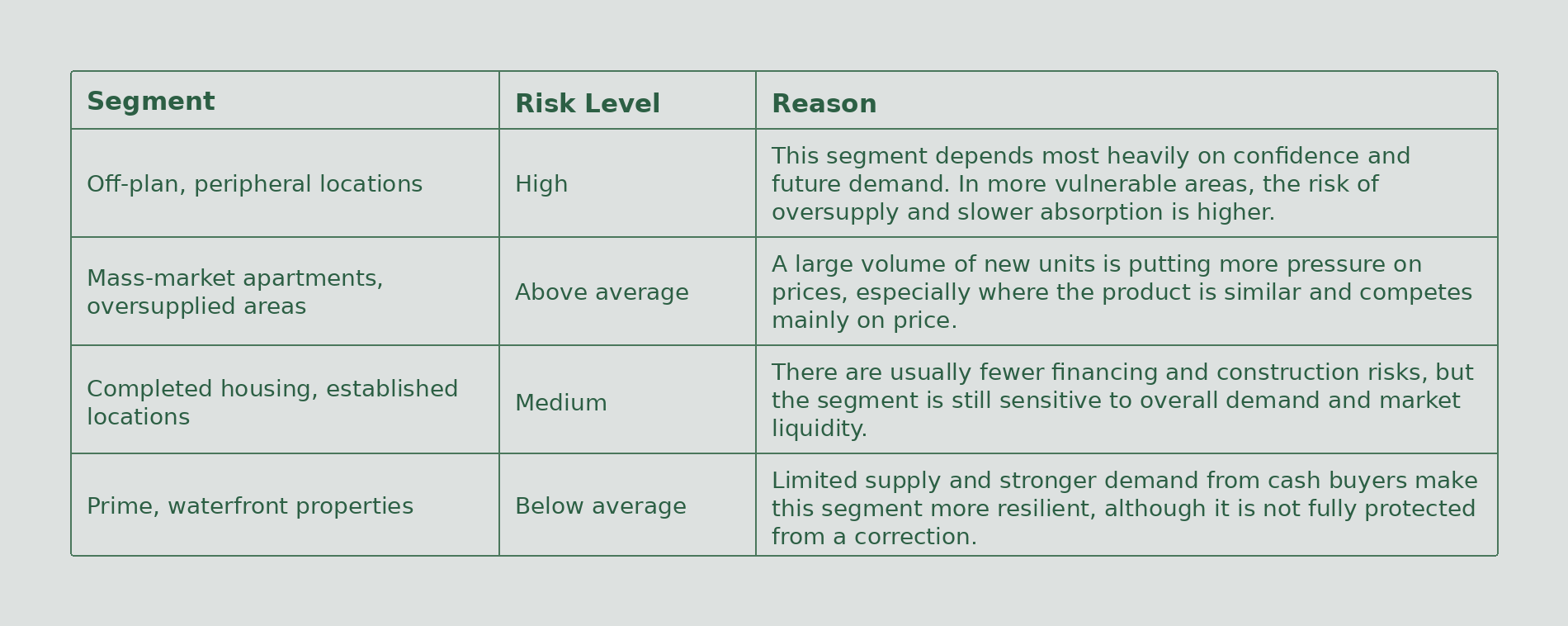
The current crisis poses the biggest risk to under-construction housing in Dubai’s more remote areas. That is where the danger of oversupply and price correction is highest, especially since 210,000 new units are expected to come to market in 2026.
Risk areas
Off-plan property in remote locations and the mid-market segment. Demand here depends more on expectations than on established liquidity, so when sentiment weakens, these projects are usually the first to lose sales momentum. If the conflict drags on, this segment could see a correction of 10–15%.
Projects priced closer to the mass market. This segment is the most exposed to the wave of new supply, because competition is driven less by uniqueness and more by price and payment terms.
More resilient segments
Completed homes in prime locations. Limited supply and already established demand make this segment more protected from a short-term shock.
Branded residences and waterfront locations. These properties tend to keep their premium because high-quality supply is limited and demand from wealthy buyers remains strong.
Three Scenarios: Where the Market Could Go Next
Scenario 1: Optimistic
De-escalation by the second quarter of 2026. In this case, the slowdown in transactions could last for 3 to 6 months, after which delayed demand would start to return and the off-plan segment would become more active again.
Scenario 2: Most likely
The most likely outcome is that uncertainty drags on. If tensions remain high for 6 to 12 months, the market could enter a period of stagnation: liquidity would weaken, sellers in the mass-market segment would be more willing to offer real discounts, and official price indices would either move sideways or decline in отдельных submarkets.
Scenario 3: Negative
The conflict drags on. If foreign demand weakens noticeably at the same time as new supply comes to market, off-plan projects and peripheral locations could see the sharpest correction, in the range of 10–15%. Prime properties, branded residences, and areas with limited supply usually hold up better, but they are not completely immune.
How to Check Whether a Property Is Really Being Sold at a Discount
To understand whether a property price is actually attractive, do not rely on listing ads alone. Look at data from real completed transactions instead. Right now, buyers have more room to negotiate.
Check the DLD data: compare the asking price in the listing with actual sale prices for similar units in the same building over the past 30 days.
Prices on the secondary market usually adjust faster. Private sellers are often more willing than large developers to lower the price.
Be careful with bonuses. Installment plans or waived service charges often replace a direct discount rather than add to it. In many cases, a straight 5–7% price cut is more выгоднее than these offers.
For any real estate transaction in the UAE, you need a manager’s cheque — a bank-issued document that confirms the buyer has the required amount for the purchase, that the money is held in a bank account, and that it has been reserved for the deal.
If you plan to pay for property with cryptocurrency, it is important to keep in mind that UAE banks may block an account if funds are withdrawn directly from a crypto exchange. 1tab helps clients obtain a manager’s cheque legally and without account freezes.
In the UAE, there is no ban on using third-party manager’s cheques to pay for real estate or other contract-based transactions. This service usually costs 1–2% of the cheque amount.
How does it work?
Contact us to discuss the terms. You will need to provide information about the seller and the deal amount.
Complete verification through KYC and AML checks.
Transfer the required amount in the way that works best for you: cash, cryptocurrency, or bank transfer. Our partners in Dubai will ring-fence the required amount and issue the manager’s cheque.
We will then hand the cheque over to you or deliver it directly to the developer or property owner if you are buying on the secondary market.
The developer or property owner deposits the manager’s cheque into their bank, and the funds usually reach their account within 24 hours.
Indicators to Watch in the Coming Weeks
Focus on real-time data, because official reports usually come with a delay of about six weeks. The main signals to watch are:
DLD weekly transaction volume. If total deal value falls and stays below AED 8–9 billion, that could mean the slowdown in demand is no longer just short-term noise and is becoming a broader trend.
The DFM index. For the housing market, the key issue is not just that the index has fallen, but whether the sell-off continues after the February peak. A move back above the February 27 level would suggest improving expectations, while another drop would show that confidence has still not recovered.
New project announcements. If Emaar, Aldar, Damac, or other major developers start delaying planned launches, it is a sign that their internal demand data is weak.
The status of Dubai airport. This is not a secondary factor but a direct economic signal. In March 2026, the airport already went through a partial shutdown followed by a limited reopening, and any new disruption would immediately hurt tourism, business activity, and the wider economy.
Oil above $100 for more than 30 consecutive days. High oil prices tighten financial conditions and reduce the purchasing power of buyers from India, Europe, and Asia.
FAQ
Has real estate in Dubai already become cheaper?
Not across the board. Activity and buyer interest have declined, but there has not been a broad-based drop in prices for completed properties yet.
Why do the news reports say the market is down 30%?
They are referring to the stock market index of listed developers, not the price per square meter in residential property. The index has indeed fallen by 30%, but prices for physical real estate in Dubai have not collapsed along with the stock market.
Which properties are the riskiest to buy right now?
Off-plan properties in peripheral areas, where oversupply is expected over the next two years. Mass-market housing in already oversupplied districts is also more vulnerable.
Can Dubai’s real estate market recover quickly?
Yes, if tensions ease by the second quarter of 2026. Dubai has gone through similar shocks before and has recovered each time. The market’s structural drivers — tax-free ownership, the Golden Visa, and rental yields of 6–9% — are still in place.
What should buyers watch first: prices or transactions?
Transactions. They usually show the market’s direction 6 to 8 weeks before official price data does. If weekly DLD transaction volumes stay above AED 10 billion for two weeks in a row, it is a sign that the market is holding steady.
Best Investment Options in the UAE
Where You Can Invest in Dubai and Other UAE Cities
What is the Manager’s Cheque in Dubai, UAE
Guidance on Bank Guarantees in the UAE
How to pay for a manager’s cheque with crypto
The Guide to Converting USDT and BTC for Dubai Real Estate Transactions
